
How Did We Get Our Bible? My Interview on the NT Canon at the Ligonier Conference

This past March I spoke at the Ligonier National Conference. My plenary address was on “The Truth about Marriage” (you can watch here), and I also did an enjoyable sit-down interview on the subject of the origins of the New Testament canon. You can watch below!
[iframe width=”600″ height=”400″ src=”https://www.youtube.com/embed/DTki0ESXIJk” title=”YouTube video player” frameborder=”0″ allow=”accelerometer; autoplay; clipboard-write; encrypted-media; gyroscope; picture-in-picture” allowfullscreen></iframe]… Continue reading...
All Gospels Are Not Created Equal: My Wall Street Journal Review of “The Apocryphal Gospels”

Most people have never read one of the “apocryphal” Gospels—that is, a gospel that was not included in our Bibles. For that matter, most people have never read one of the canonical Gospels: Matthew, Mark, Luke and John. Perhaps they’ve read snippets here and there, but very few have read them straight through.
Even so, there seems to be no shortage of opinions about the nature of ancient Gospels and how they functioned in the early church. Dramatic claims—typically filtered through blog articles and internet lore—are the order of the day. There were hundreds of “other” Gospels in the early church, we are told. No one knew which Gospels they … Continue reading...
Is the Concept of a “Self-Authenticating” Bible a Modern Invention?

How do we know which books are from God, and which are not? Certainly the apostolic origins of a book can help identify it as being from God (see post here). And, the church’s overall consensus on a book can be part of how we identity it as being from God (see post here).
But, Christian theologians—especially in the Reformed world—have long argued that there is a more foundational way we can know books are from God: the internal qualities of the books themselves.
In other words, they have argued that these books bear certain attributes (Latin indicia) that distinguished them as being from God. They argued … Continue reading...
Looking for Brief and Accessible Books on the Origins of the Biblical Canon? Here are Two Good Ones

Whenever I speak on the origins of the New Testament canon, I am regularly asked about whether there are brief, accessible books on the subject—the kind that could be given to lay folks in the church. Unfortunately, my books on canon usually don’t qualify (e.g., Canon Revisited clocks in at over 300 pages).
For years, I have been asked to write a shorter version, but just haven’t had the time. Thankfully, others have stepped in to fill that gap. Let me mention two wonderful little books that have just come out in the last few years.
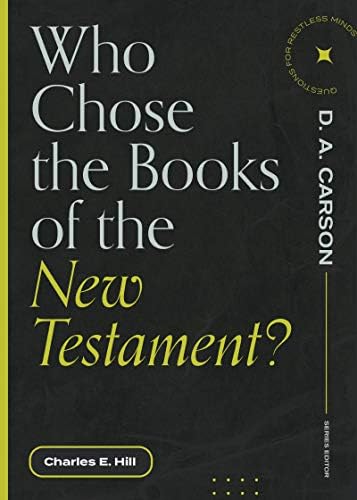 Just this year, Chuck Hill, professor emeritus of New Testament at RTS Orlando, has … Continue reading...
Jesus in the Canonical and Apocryphal Gospels: Simon Gathercole to Give Harold O.J. Brown Lectures at @RTSCharlotte
For our annual Harold O.J. Brown Lectures at RTS Charlotte, we are pleased to Welcome Dr. Simon Gathercole, professor of New Testament and Early Christianity at Cambridge University.
On March 22, 11AM-2PM, Dr. Gathercole will be giving two lectures (with a provided lunch in between) on the theme of “Jesus in Canonical and Apocryphal Gospels.”
Certainly this lecture will be of great interest to all who want to understand what makes our gospels unique as opposed to the variety of apocryphal gospels in existence. I am particularly interested in this topic myself as I did my Ph.D. research on an apocryphal gospel fragment, P.Oxy. 840 (see my book, The … Continue reading...