
Ten Basic Facts about the NT Canon that Every Christian Should Memorize: #9: “Christians Did Disagree about the Canonicity of Some NT Books”

Note: for the full series, see here.
When it comes to basic facts that all Christians should know about the canon, it is important that we recognize that the development of the canon was not always neat and tidy. It was not a pristine, problem-free process where everyone agreed on everything right from the outset.
On the contrary, the history of the canon is, at points, quite tumultuous. Some Christians received books that were later rejected and regarded as apocryphal (this was discussed in an earlier post). More than this, there was disagreement at times even over some canonical books.
For instance, Origen mentions that books like 2 … Continue reading...
Ten Basic Facts about the NT Canon that Every Christian Should Memorize: #8: “The NT Canon Was Not Decided at Nicea—Nor Any Other Church Council.”

Note: Full blog series can be found here.
For whatever set of reasons, there is a widespread belief out there (internet, popular books) that the New Testament canon was decided at the Council of Nicea in 325 AD—under the conspiratorial influence of Constantine. The fact that this claim was made in Dan Brown’s best-seller The Da Vinci Code shows how widespread it really is. Brown did not make up this belief; he simply used it in his book.
The problem with this belief, however, is that it is patently false. The Council of Nicea had nothing to do with the formation of the New Testament canon (nor did Constantine).… Continue reading...
Ten Basic Facts about the NT Canon that Every Christian Should Memorize: #7: “Early Christians Often Used Non-Canonical Writings.”

Full blog series can be found here.
For Christians struggling to understand the development of the New Testament canon, one of the most confusing (and perhaps concerning) facts is that early Christian writers often cited from and used non-canonical writings. In other words, early Christians did not just use books from our current New Testament, but also read books like the Shepherd of Hermas, the Gospel of Peter, and the Epistle of Barnabas.
Usually Christians discover this fact as they read a book or article that is highly critical of the New Testament canon, and this fact is used as a reason to think that our … Continue reading...
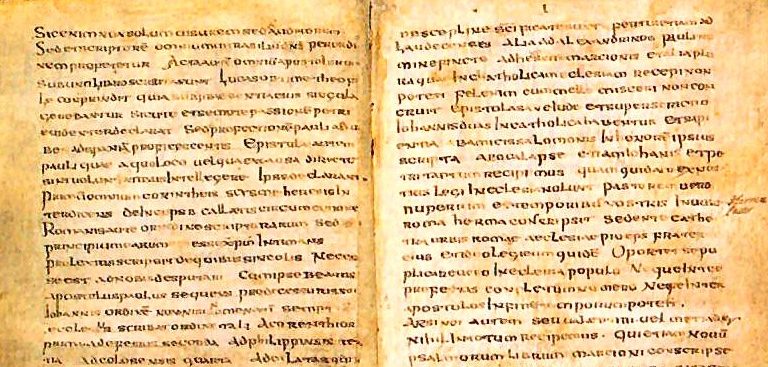
Ten Basic Facts about the NT Canon that Every Christian Should Memorize: #6: “At the End of the Second Century, the Muratorian Fragment lists 22 of our 27 NT books”
Note: See the full blog series here.
This series is designed to introduce lay Christians to the basic facts of how the New Testament canon developed. One of the key data points in any discussion of canon is something called the Muratorian fragment (also known as the Muratorian canon). This fragment, named after its discoverer Ludovico Antonio Muratori, contains our earliest list of the books in the New Testament. While the fragment itself dates from the 7th or 8th century, the list it contains was originally written in Greek and dates back to the end of the second century (c.180).
Some have argued that the list should be dated … Continue reading...
The Formation of the Biblical Canon: My Review of Lee McDonald’s Latest Book

Note: The review below was just published in the latest issue of Themelios.
I have enjoyed reading Lee McDonald’s many works on the NT canon. He has established himself as one of the leading voices in this area through his numerous books and articles. So I was pleased to see this latest volume, Formation of the Bible: The Story of the Church’s Canon (Hendrickson, 2012), which is intended to be a lay-level introduction to the origins of the Bible. There are very few introductory works on this subject matter (a point McDonald makes in the preface), so it is good to see something written for the person in the … Continue reading...