
In a prior blog post, I announced the forthcoming release of the new book I co-authored with my wife Melissa, entitled: The Good News Family Devotional: 52 Weeks in the Gospel of Mark.
This book is designed to fill a gap in family devotionals because it is written by both a mom and a dad, and also designed to reach both the parent and the child. It releases on May 5th so keep an eye out!
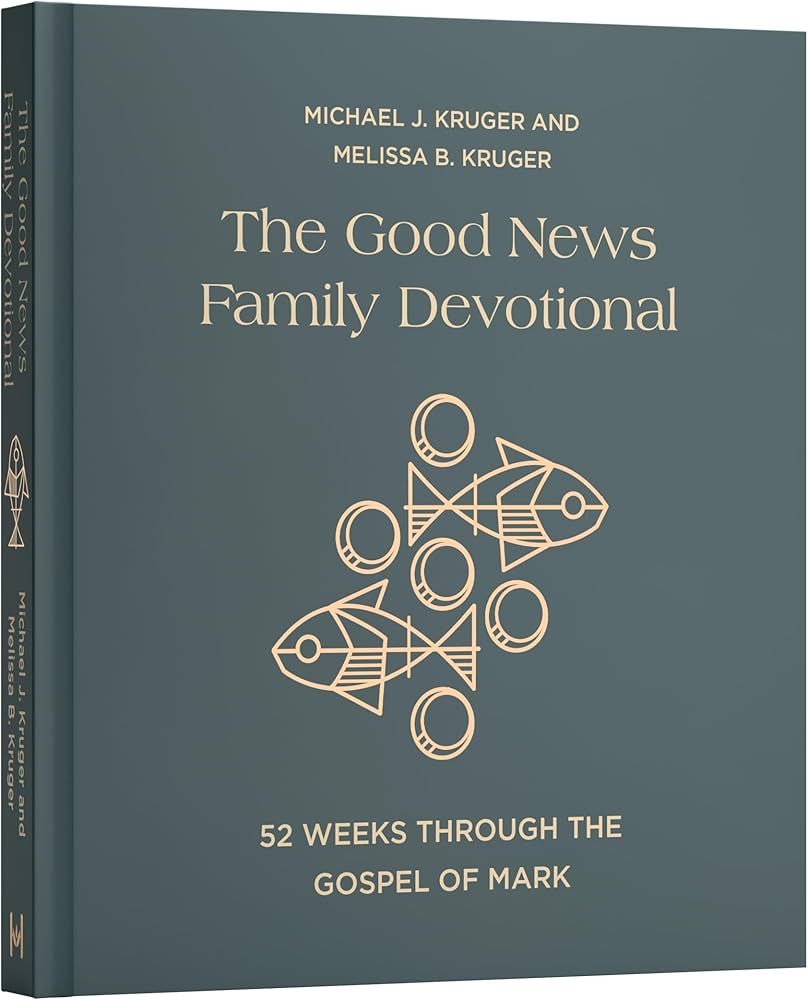 In light of this forthcoming book, I am doing a short 3-part blog series in the month of April designed to highlight a number of key lessons on parenting we have learned over the years. All of these lessons are designed to combat one of those common issues for parents: anxiety over how their children will turn out.
The Anxious Parents Club
Anxious parents are not hard to spot. If they have young kids, they can be stressed and tired, concerned about germs and illness, ultra safety-conscious, and overly protective. If they have older kids, they might be worried about success in sports, academic achievement, and when to buy them a mobile phone.
I should know because I was—and still am—one of these anxious parents. My children are now grown, but when they were younger, I fit the above description pretty accurately. Just ask my kids how long I made them wear life vests at the lake!
For those of us who are part of the anxious parents club, the response to our worry is fairly predictable. We try to control as much of our children’s life as possible. We want to control their behavior, their social life, their grades. And it never stops.
If you think about it, any attempt to maintain absolute control of our lives, and the lives of our kids, is just an attempt to take on the role that belongs only to God. God is the only one who is actually in control. That’s his job, not ours. And when we try to take control, we live a life of inevitable frustration and disappointment. We make lousy gods.
So, is there any hope for anxious parents who are tempted to try and take control? Yes! What we need is to move our attention off the particular issue we are worried about, and onto the big picture principles that give us hope.
The Influence of Families
Thus, we come to the first of these principles. We need to remember that God works through families. Not only did God create the family unit, but the Bible is filled with examples that a primary means God uses to spread the gospel through the world is by parents passing it down to their children.
When Paul writes to Timothy—his protégé in the ministry—he reminds Timothy that he learned the gospel from his mother Eunice and that she had learned the gospel from her mother Lois (2 Tim 1:4).
Elsewhere, Paul encourages Timothy to stay strong in the truth by remembering “from where you learned it and how from childhood you have been acquainted with the sacred writings, which are able to make you wise for salvation” (2 Tim 3:14-15).
This is a remarkable picture of the power of parental influence. Essentially, Paul calls upon Timothy to stick with truth precisely because of who he learned it from—his family. He wants Timothy to harken back to his childhood and keep to the principles he learned there.
In many ways, this is an echo of Jesus’s own teachings where he reminds us that “whoever does not receive the kingdom of God like a child shall not enter it” (Mark 10:14). We all need childlike faith to enter God’s kingdom and the best place to learn that childlike faith is, well, when you’re a child!
Children Listen More Than We Think
And this reality finds confirmation in sociological studies that have repeatedly shown that the single, most powerful influence on the religious lives of American teenagers is not their peers, or even social media. It’s their parents.
For a lot of parents out there, this will seem shocking. Most of the time it doesn’t seem like our kids are listening to us at all. In fact, it may seem like our kids are ignoring our advice, our even rejecting it outright.
But we have to remember to play the long game. Teaching our children God’s word is like sowing seeds in the ground. It takes a while—sometimes a long while—before you see results. Just like the farmer waits patiently for his crops, so we wait patiently for the Lord to do what he promised. As God declares through the prophet Isaiah, “My word that goes out from my mouth; it shall not return to me empty, but it shall accomplish that which I purpose” (Is 55:11).
Does that mean that all children of Christian parents will automatically become believers and turn out exactly as we hoped? Nope. There are many stories of faithful Christian parents who have wayward children.
But acknowledging that fact does not mean that Christian parenting doesn’t matter. While Christian parenting is not the ultimate cause of our child’s future (that’s in God’s hands), it is still the primary means that God uses to influence our child’s future.
This is why the book of Proverbs can say with confidence that “Train up a child in the way he should go, and when he is old he will not depart from it” (Prov 22:6). Or, as the title of this article says, God works through families.
So, take hope. Your children are listening to you (and watching your example) more than you think.