
Announcing My New Book with Oxford University Press

Since this blog is primarily designed to put out lay-level content on the origins of the New Testament (among other issues), I don’t normally talk about the more technical scholarly projects I am working on behind the scenes. So, here’s a little update on what I’ve been up to academically.
1. First, I am pleased to announce that I have signed a contract with Oxford University Press for a forthcoming volume entitled, Miniature Codices in Early Christianity. The volume will be appearing in the Oxford Early Christian Studies series.
I have been working on the subject of miniature codices for more than twenty years now, ever since doing my … Continue reading...
One of the Core Markers of Early Christian Identity

One of the most notable features of early Christianity is that it was a religion concerned with books. Particularly, scriptural books.
As Margaret Mitchell observed, “Christianity was a religious movement with texts at its very heart and soul, in its background and foreground. Its communities were characterized by a pervading, even obsessive preoccupation with and habitus for sacred literature.”
Now, to modern ears, this doesn’t seem all that noteworthy. Given our historical situation—a world dominated by Judaism, Christianity, and Islam—it seems quite normal for a religion to be bookish.
But it was not always so. In the ancient Greco-Roman world, books were rarely used in religious settings. Other than … Continue reading...
One of the Most Important Ministry Skills That Nobody Talks About
 … Continue reading...
 Is the Book of James Really ‘An Epistle of Straw’?

We have a lot of books in our New Testament. All of them, we believe, are divinely inspired. And yet we don’t spend equal amounts of time reading them. For most of us, our reading pattern is profoundly lopsided, focusing mostly on Paul (especially Romans and Galatians) and the Gospels (with John leading the way). Indeed, some books (like 3 John) hardly get read at all.
This trend raises intriguing questions about why certain books were even included in the New Testament. What purpose do these less famous books serve? This becomes particularly acute with the book of James. Although 500 years have passed since Martin Luther called it … Continue reading...
Recent Books on the Paratextual Features of Early Christian Manuscripts
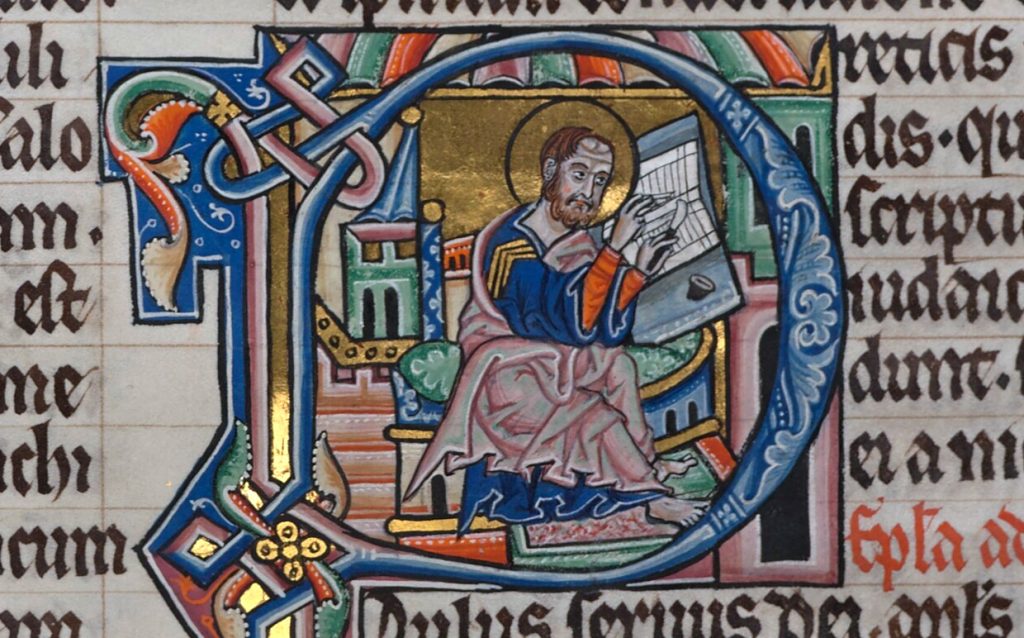
There is more to a text than merely the words on the page.
This is a principle that is often missed, even by modern readers. When a person reads a book, of course the intellectual attention is primarily centered upon the words and the meaning of those words. But, most readers don’t realize that there are many factors beyond the words that affect one’s reading experience. Such factors often go unnoticed as they operate in the background, often imperceptibly.
Some examples of such “paratextual” features: the size of the page, the size of the font, the spacing between lines, the margins/borders, the use/non-use of color, section headings, chapter headings, the … Continue reading...