
It goes without saying that not all academic sub-disciplines (especially in the field of biblical studies) generate the same level of scholarly interest. Some fields are more active; others less so. And it can change from generation to generation.
When I was doing my work with Larry Hurtado years ago at the University of Edinburgh, I always wondered if my sub-discipline of New Testament canon (and sub-sub-disciplines of NT text and apocryphal writings) would continue to generate academic discussion and interest in the years ahead.
Looking back, I can say that I am grateful that field of New Testament canon (and text) has continued to produce a lot of academic (and popular) interest, perhaps as much as ever. In fact, I have continued to highlight recent publications on this blog, though I find myself falling woefully behind. For a few recent examples, see here, here, and here.
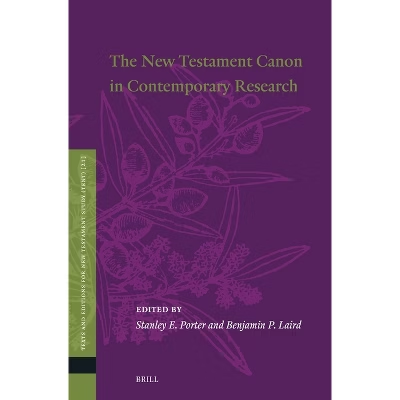 On that note, I am please to mention a brand new release: The New Testament Canon in Contemporary Research, edited by Stanley E. Porter and Benjamin P. Laird (Brill, 2026). This is the latest installment in Brill’s Text and Editions for New Testament Studies Series (#21).
This is an impressive volume clocking in at 656 pages, and 23 individual chapters, covering a wide range of important issues related to the development of the New Testament. There are nine distinction sections:
1. What Were the Leading Factors that Prompted the Formation of the New Testament Canon?
2. When Did the Core of the New Testament First Become Recognized, and When Was the Complete New Testament Fixed?
3. What Was the Early Christian Perspective on Pseudepigraphy, and How Did the Practice Influence Canon Formation?
4. When and How Did the Fourfold Gospel Collection Gain Canonical Recognition?
5. When and How Did the Catholic Epistles Gain Canonical Recognition?
6. When and How Did the Pauline Epistles Gain Canonical Recognition?
7. When and How Did the Book of Revelation Gain Canonical Recognition?
8. What Do the Ancient Textual Witnesses Reveal about the Development of the Canon?
9. What Do the Church Fathers Reveal about the Development of the Canon?
In addition to these nine sections—which demonstrate the remarkable breadth of this volume—there is an impressive group of scholars gathered together. In order of appearance, there are contributions from Benjamin Laird, Tobias Nicklas, Tomas Bokedal, Dimitris Kyrtatas, Markus Vinzent, Mark Edwards, L. Scott Kellum, Craig D. Allert, Jeremy Duff, Lee Martin MacDonald, Charles E. Hill, Jason, David BeDuhn, Gregory Goswell, Wolfgang Grünstäudl, Stanley E. Porter, Robert W. Wall, Eugenia Scarvelis Constantinou, W. Gordon Campbell, Hans Förster, Gregory R. Lanier, Paul Foster, and Paul A. Hartog.
My own chapter, which happens to be first in the volume, is entitled, “Inspiration and the Formation of the New Testament Canon” and tackles the long-standing debate about whether the early church fathers saw their own writings (and words) as equally “inspired” as the New Testament writings themselves. Here is the abstract of my chapter:
There has been a long-standing debate among scholars about the role of inspiration in the emergence of the New Testament canon. Prior generations of scholars have argued that inspiration could not have played a role in the acceptance or rejection of books because patristic writers believed inspiration was a broad category that extended to non-canonical books and even to their own writings. This chapter argues that the internal/aesthetic qualities of books (and the perception that they came from God) did, in fact, play a role in their acceptance. Early patristic writers, therefore, had two different concepts of “inspiration”—a primary inspiration attributed to apostolic writings, and a secondary inspiration attributed to other ecclesiastical writings. And many patristic writers believed that primary inspiration could be identified by observing the internal qualities of the books themselves.
In sum, this volume looks to be an excellent and worthwhile contribution to recent canon discussions, and a fitting successor to the 2002 volume, The Canon Debate, which also was a lengthy collection of essays on various topics related to the origins of the canon (though half was devoted to the OT/Hebrew Canon whereas the new Brill volume is focused only the New).
At this point, my only complaint about the book is the standard one, which is the price: $185! Although I get to enjoy a complimentary copy as one of the contributors, I suppose others will need to start saving now, or find it a major research library. Regardless, this volume looks to make a needed contribution to the ever-growing field of canon studies.