
Without a doubt, the centerpiece of early Christian theology was the crucifixion of Jesus of Nazareth. The Gospels themselves demonstrate this focus by devoting the vast proportion of their time to the final the final week of Christ’s life, known as his “passion.” So lopsided are the Gospels, that Martin Kahler once quipped that they were basically “a passion narrative with an extended introduction.”
Paul likewise spends a considerable amount of time on the crucifixion itself. In particular, he likes to describe the purpose of Jesus’s death: “For I delivered to you as of first importance what I also received: that Christ died for our sins in accordance with the Scriptures” (1 Cor 15:3).
Not surprisingly, the cross is the most recognizable Christian symbol, both in the ancient world and in the modern world. Christian art has been particularly obsessed with depictions of the crucifixion ranging from the famed art of the Italian Renaissance to medieval frescoes on the walls of basilicas.
Oldest Images of the Crucifixion
But that raises an interesting question: What is the oldest image of Jesus hanging on the cross? How far back did Christians visually depict the crucifixion?
Some may tout the Alexamenos graffito as the oldest depiction of the crucifixion. This is a rudimentary Roman drawing—literally graffiti—dated to the third century and depicting a man hanging on a cross with the head of a donkey. The inscription reads, “Alexamenos worships his god.”
So, is this the earliest Christian depiction of Jesus on the cross? Nope. For one, it is not an image drawn by a Christian but by someone who wanted to mock Christians. So, it’s not a Christian image, per se. Regardless, we have a depiction of the crucifixion that pre-dates the Alexamenos graffito. And this depiction is definitely Christian.
It is called the Staurogram.
A Distinctive Scribal Feature
The Staurogram is the name of a particular abbreviation used by early Christian scribes when they copied New Testament books. When scribes came across the Greek words stauros (“cross”) or staurao (“crucify”), they did something rather remarkable. They took the letter T (tau) and the letter R (rho) and superimposed them on one another.
Let me explain.
To understand what’s happening with the Staurogram, you have to consider the shapes of the individual letters. The Greek tau looks like an English “T” and the Greek rho looks like an English “P.” But when laid over the top of one another you get an image that looks like this:
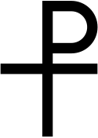
What’s so significant about this image? Well, the “T” is obviously a natural image of the cross. And when you add the “P” it gives the impression of head of a human being hanging on the cross. If you imagine the head hung to one side (which was common in crucifixion) the image is easier to see.
It becomes a bit clearer when you see it in an actualy Christian manuscript. We have images of the Staurogram in P45, P66, and P75—all third century manuscripts. But scholars agree the use of the Staurogram must go back well into the second century. Here’s a glimpse of the image in P75:
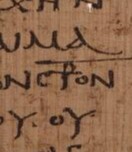
You can see the image of the “P” looks like the head of a crucified person hanging on the cross. Also note that the vowels in the middle of the word stauro are dropped and a line is placed over the top, marking this as an abbreviation not unlike the nomina sacra.
A Key Christian Symbol
While the Staurogram originated as a scribal convention, it soon took on a life of its own. The tau-rho combination began to be used as a distinctive Christian symbol, apart from its appearance in manuscripts. Thus, we find that symbol used throughout early Christianity, inscribed on walls, stone, and even coins.
As a personal example, I just returned from a trip to Turkey where we surveyed the ruins of the seven churches of Revelation. While walking down the agora in Ephesus, I spotted this symbol etched in stone along the side of the pathway.
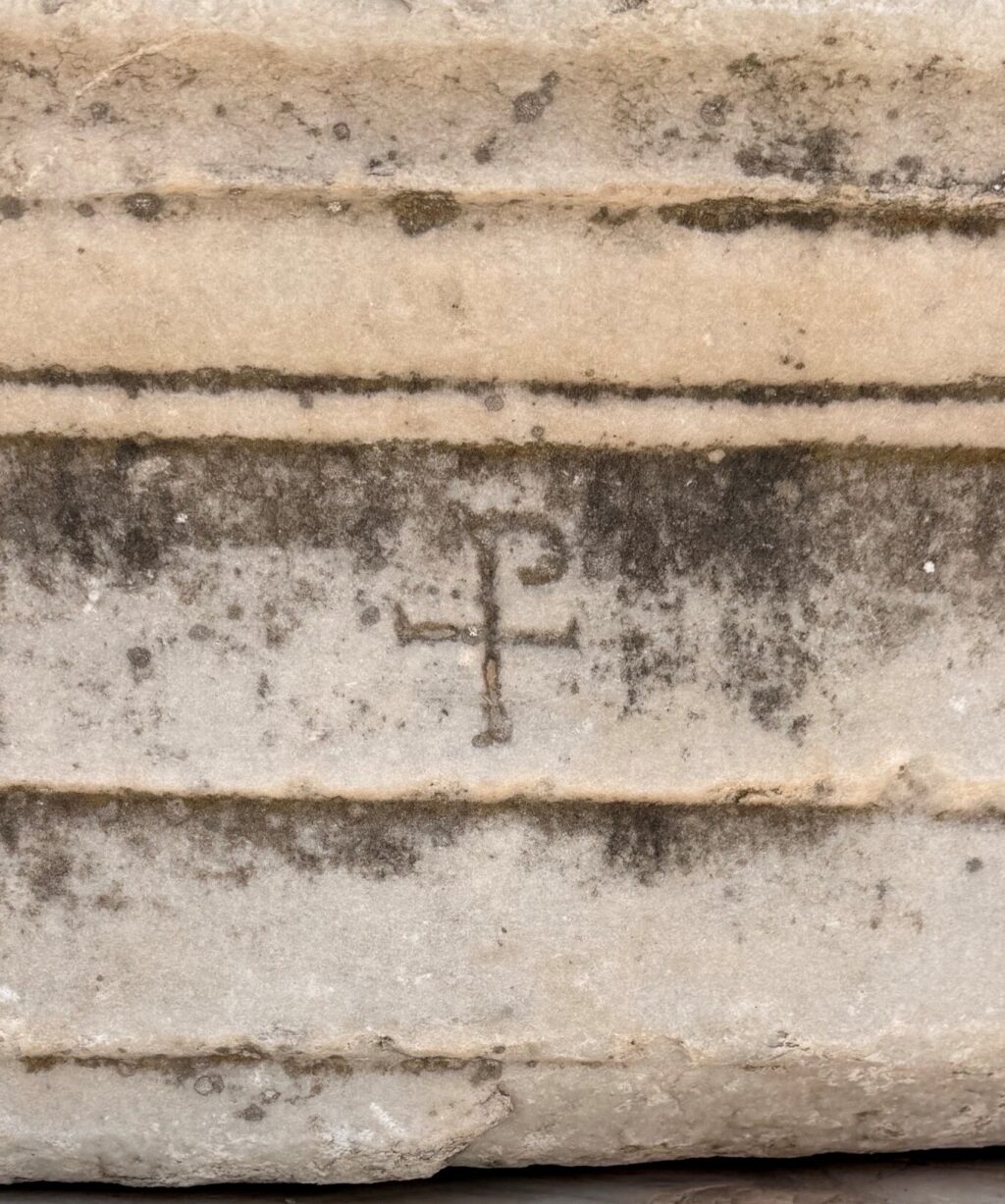
There was no plaque nearby, nor were any of the guides making note of it. But it clearly looks like a Staurogram.
It’s true that the tau-rho combination occurs occasionally in non-Christian contexts, sometimes as abbreviations for other words that have this same letter combo. But the context would usually indicate such a usage. In this case, the symbol is alone, isolated on the stone, and no other usage is obvious (at least in the limited time I examined it).
The Centrality of the Cross
So, what’s the significance of the Staurogram? Why does it matter?
For one, it was a picture of early Christian devotion to the crucifixion event as central to their faith. This would be noteworthy in a Roman context where crucifixion was viewed as the highest form of humiliation—as indicated by the Alexamenos graffiti mentioned above.
Regardless of the ridicule, Christians were eager to publicly associate themselves with an image that the rest of the world regarded as offensive and foolish. As Paul states plainly, “For the word of the cross is folly to those who are perishing… [and] folly to the Gentiles” (1 Cor 1:18, 23).
Beyond this, the Staurogram also provides our earliest glimpse into the beginning of Christian art. It was not merely a textual device, a but a visual expression of early Christian devotion to Jesus, particularly the crucified Jesus.